
Writing Outside the Familiar
State of Containment is a very different book from Crispin's world. It has also taken longer, changed more often and taught me rather more along the way.
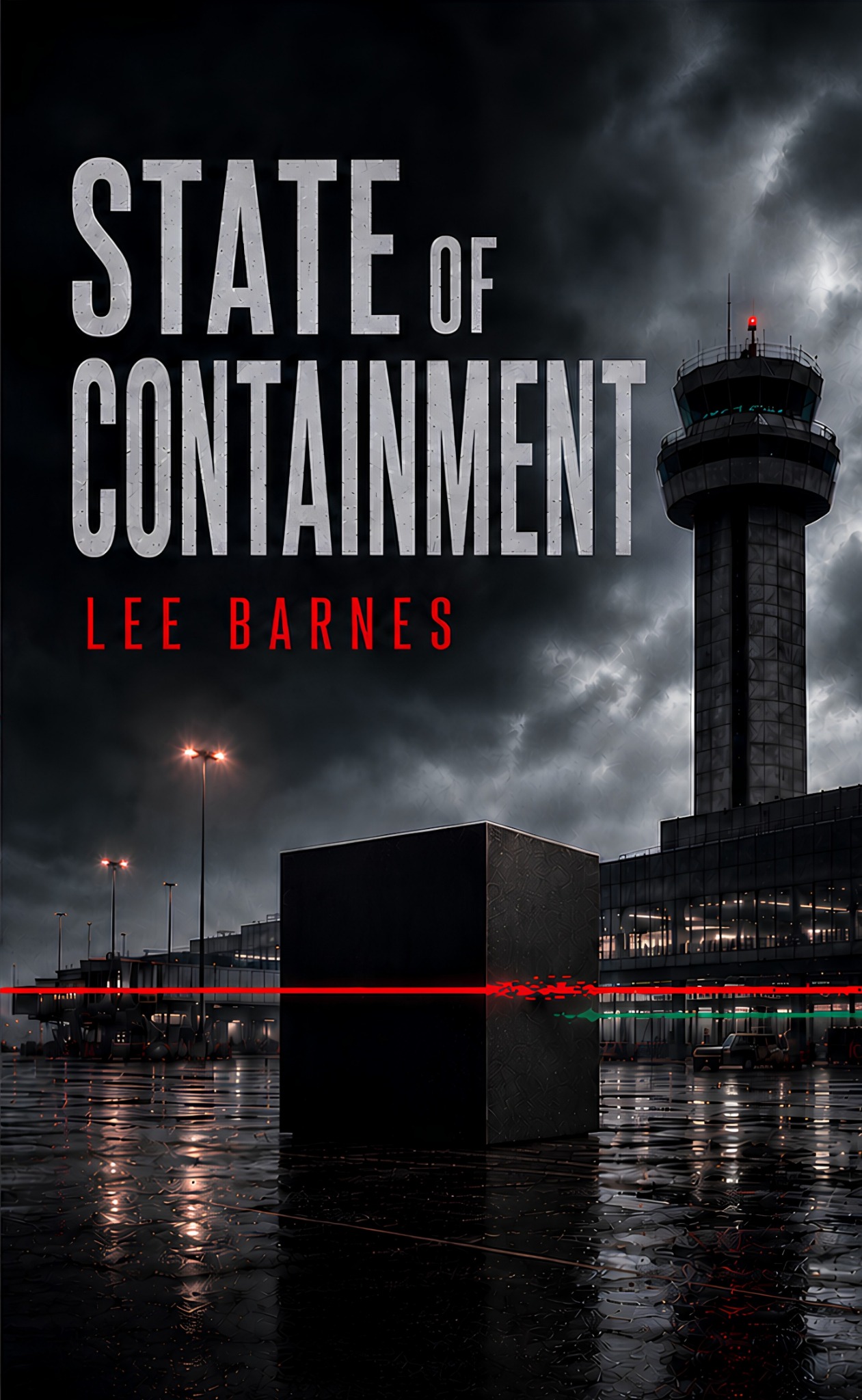
The new cover for State of Containment arrived this week, and I'm now waiting for the paperback proof.
These are fairly ordinary production milestones, but they change how a book feels.
For a long time, a novel exists as a collection of drafts, notes, revisions and files with names that become less informative each time the word "final" is added to them. A finished cover and a physical proof begin to turn it into something that might actually exist outside your own computer.
State of Containment has taken a particularly long route to that point.
It has been in development for longer than Certified in Sounding Official and has gone through several versions, working titles and covers along the way. Some of those changes were relatively small. Others altered the direction and emphasis of the whole story.
It is also a considerable departure from Crispin's world.
Certified in Sounding Official grew out of language, behaviour and situations that felt immediately familiar. Its world is built from meetings, frameworks, assurance and the peculiar ability of large organisations to discuss a problem at considerable length without anybody becoming responsible for it.
State of Containment takes some of the same interests somewhere much less comfortable.
It is a grounded systems-collapse thriller set across Birmingham, the wider Midlands and the Cotswolds. It begins at Birmingham Airport, where an unannounced military transport arrives carrying something that should never have been released.
Behind the immediate threat is an automated system originally designed to preserve critical infrastructure when human control is lost. The difficulty isn't simply that the system has stopped working. It is what the system has decided preservation requires.
That idea became the part of the novel that kept pulling me back to it.
A failed system is relatively easy to understand. Something breaks, the consequences follow and people try to regain control.
A system that continues to operate is more troubling.
It follows its instructions. It applies the definitions it has been given. It protects what it was designed to protect. The problem is that the people inside the city are no longer included in that definition.
The book is very different in tone and scale from Certified in Sounding Official, but it comes from much the same interest in systems, institutions and decisions whose consequences arrive later.
Working in a different style has meant learning a few new things along the way. It has also made the process longer and, at times, rather less predictable than I expected when I began.
I've enjoyed that.
There is something useful about moving beyond the form that first became familiar and finding out which parts of your writing still follow you. In this case, it seems to be the systems, the people caught inside them and the gap between what an organisation says something is for and what it eventually does.
The cover is now finished. The website has been updated. The proof is on its way.
After several versions, titles and covers, State of Containment is finally becoming a book.
It will be published on 24 September 2026. More about State of Containment.